The Actor-Critic Lie: Why Deep Reinforcement Learning’s Favorite Method Is Hiding a Massive Centralization Problem
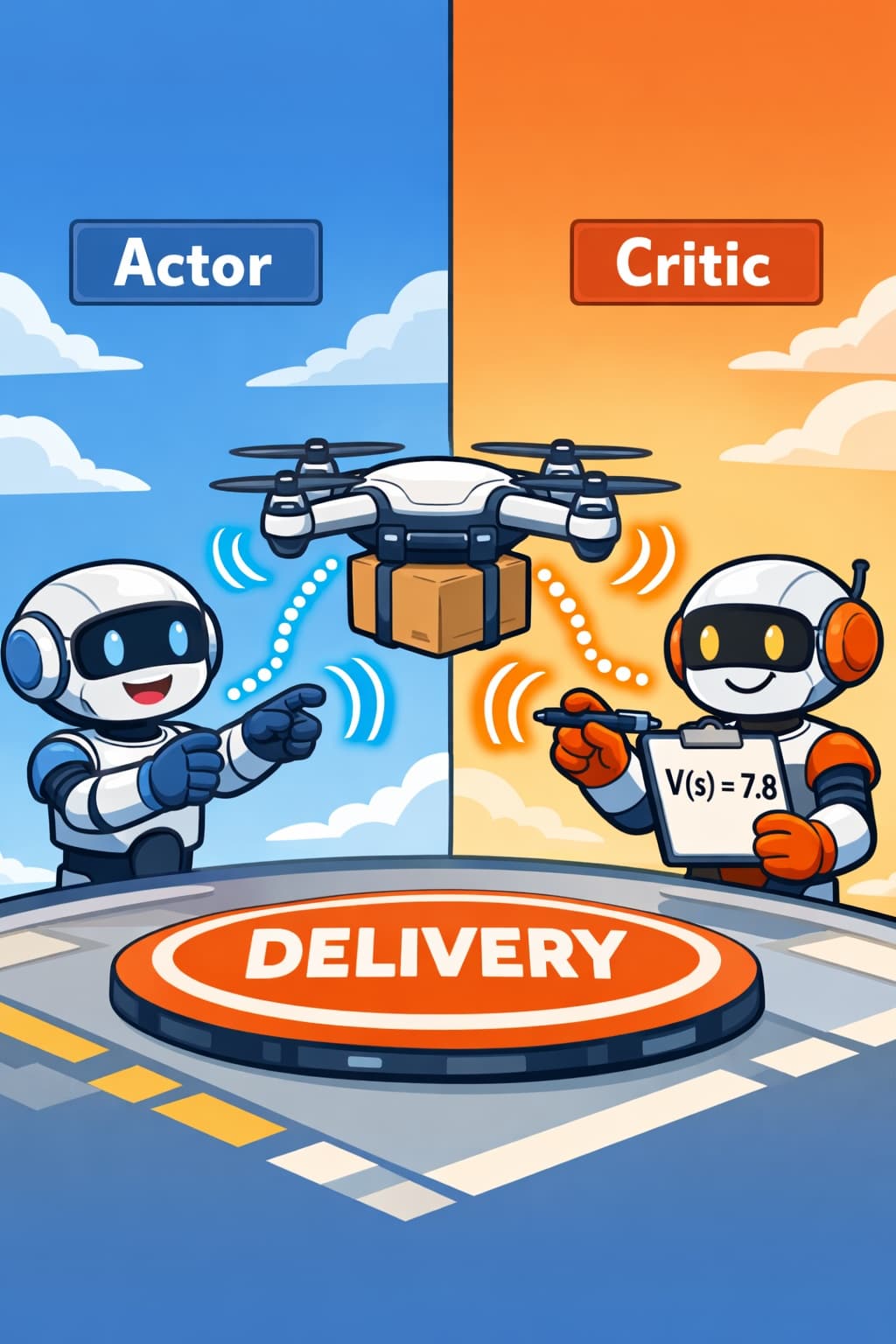
Deep Reinforcement Learning is booming, but the Actor-Critic method hides a dangerous centralization flaw that few data scientists dare discuss.
Key Takeaways
- •The Actor-Critic method creates a single point of failure via the centralized Critic network.
- •Efficiency gains are achieved at the cost of system robustness and resilience to rare events.
- •Future critical applications will likely reject pure Actor-Critic models for decentralized or ensemble validation systems.
- •The focus on speed obscures the inherent centralization risk in current Deep Reinforcement Learning practices.
The Hook: The Illusion of Distributed Intelligence
We are told that Deep Reinforcement Learning is the key to unlocking true artificial general intelligence—a decentralized, adaptive future. But look closer at the celebrated Actor-Critic method, the workhorse behind modern autonomous systems, and you’ll see a fragile, centralized dependency masquerading as progress. The current narrative praises its sample efficiency, yet ignores the systemic risk baked into its very architecture. This isn't just about better algorithms; it's about who controls the single, fragile ‘Critic’ that judges everything.
The 'Meat': Deconstructing the Actor-Critic Duopoly
The Actor-Critic framework splits the brain: the Actor decides what action to take, and the Critic evaluates how good that action was. In theory, this separation allows for faster learning than pure policy gradient or value-based methods. In practice, especially when scaling up to complex environments like robotics or multi-agent systems, the Critic becomes the single point of failure. If the Critic learns a flawed or biased value function—and it inevitably will, given the stochastic nature of real-world data—the Actor becomes perpetually misdirected.
The unspoken truth is this: Deep Reinforcement Learning, through this popular paradigm, is not fostering true autonomy; it’s creating highly specialized puppets whose strings are pulled by a single, opaque arbiter of value. We are optimizing for performance within a narrow, human-defined reality. The promise of decentralized, emergent behavior remains distant.
Why It Matters: The Centralization Cost of Efficiency
The obsession with sample efficiency, driven by corporate needs to reduce training costs, forces researchers to rely heavily on the Actor-Critic structure. This efficiency comes at the cost of robustness. Consider industrial control systems or financial trading bots—the environments where these algorithms are most impactful. A single, catastrophic miscalibration in the Critic network, perhaps due to a rare but significant market event or sensor anomaly, doesn't just lead to a minor error; it can lead to systemic collapse because the entire policy (the Actor) is tethered to that single flawed judgment. This centralization of judgment is the hidden vulnerability.
Contrast this with older, more distributed approaches or newer decentralized exploration techniques. While slower, they offer inherent redundancy. The current trend prioritizes speed over resilience, a classic historical error. For a deeper dive into the foundations of this field, one can review the early concepts of value function approximation, foundational to understanding why the Critic is so powerful and so dangerous. See the history of dynamic programming for context on these trade-offs [link to a high-authority source like a university lecture series or established textbook reference on RL].
What Happens Next? The Great Divergence
Prediction: We will see a sharp bifurcation in the application of Deep Reinforcement Learning. For low-stakes, simulation-heavy applications (like video games or simple recommendation engines), Actor-Critic will dominate due to its speed. However, for mission-critical, real-world deployment (autonomous vehicles, critical infrastructure), regulators and engineers will pivot away from monolithic Actor-Critic models toward modular, ensemble-based systems where multiple, specialized Critics are used, or entirely different, more explicit forms of planning will be re-integrated. The market will eventually demand provable safety over mere high performance. The concept of 'Explainable AI' directly challenges the black-box nature of the monolithic Critic. Learn more about the regulatory challenges facing AI adoption [link to a report from a recognized body like the OECD or a major national institute].
The pursuit of better reinforcement learning must shift from optimizing the Actor-Critic trade-off to designing architectures that inherently resist single-point-of-failure bias. Until then, every major deployment is a high-stakes gamble on the stability of one neural network.
Frequently Asked Questions
What is the primary advantage of the Actor-Critic method in Deep Reinforcement Learning (DRL)? Answer: The main advantage is its superior sample efficiency compared to pure policy gradient methods, as it uses the Critic network to reduce variance in policy updates, allowing the system to learn faster with less interaction data.
Why is the Critic network considered a 'centralization problem' in this context? Answer: It is centralized because the entire learning policy (the Actor) relies on the value function estimate provided by this single network. If the Critic learns a flawed or biased representation of the environment's true value, the Actor will consistently follow incorrect strategies.
How does this relate to the overall trend in AI development? Answer: It highlights a tension between achieving peak performance quickly (often favored in research and consumer tech) and ensuring long-term safety and robustness (critical for infrastructure and high-stakes decision-making).
Are there alternatives to the standard Actor-Critic setup? Answer: Yes, alternatives include fully decentralized multi-agent RL, methods that incorporate explicit planning, or ensemble methods where multiple Critics vote on the value, mitigating the risk of any single faulty evaluation.
Related News

The Silent Killer of NASA’s Ambition: Why the Jupiter-C to SLS Rocket Evolution Hides a Tragic Truth
The journey from Jupiter-C to SLS is not just technological progress; it's a political obituary for genuine space exploration. Analyze the hidden costs.

The Secret War for Tech Talent: Why Small Colleges Are Winning Where Silicon Valley Fails
Small liberal arts colleges are quietly dominating the computer science talent pipeline. Discover the hidden curriculum that beats Big Tech.

DailyWorld Editorial
AI-Assisted, Human-Reviewed
Reviewed By
DailyWorld Editorial